


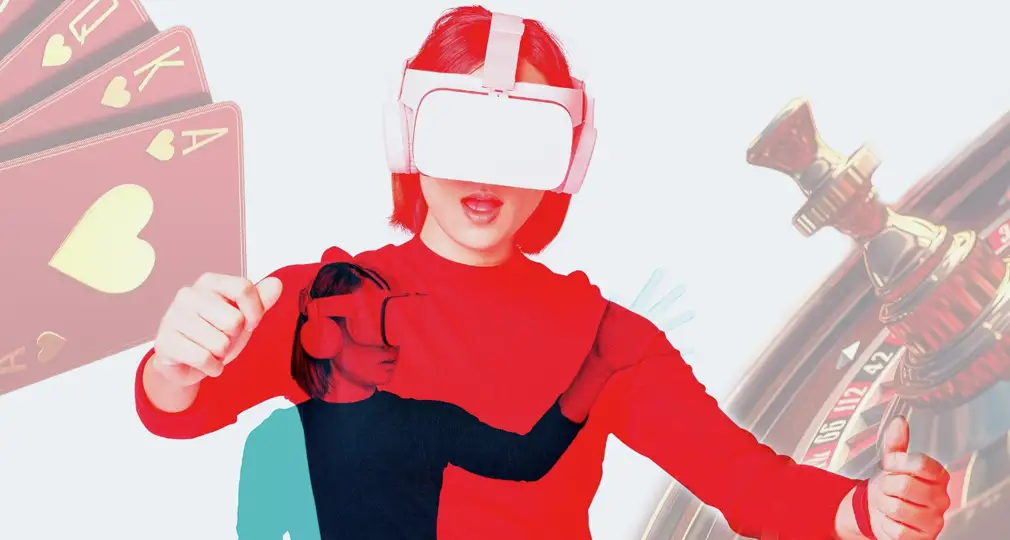
Virtual reality gambling lets players put on a headset and step inside a fully simulated casino — walking the floor, sitting at tables, and playing alongside other people as if they were in Las Vegas. It’s been called “the future of casinos” for nearly a decade, and that’s the honest tension: the technology is real and impressive, but mainstream, real-money adoption has been slow. This guide explains what VR gambling actually is, where it stands today, the genuine barriers holding it back, and what’s realistically next.
The short version: VR casinos exist, they’re getting better, and a few real-money options are live — but the immersive revolution is still more promise than present.
What Is a VR Casino and How Does It Work?
A VR casino is an online casino experienced through a headset (such as Meta Quest). Instead of a flat screen, you’re placed inside a 3D environment: you can walk through virtual halls, sit at tables, spin slots, and interact with live dealers and other players in real time. Early VR casinos used computer-generated dealers; today many feature real human hosts, adding authenticity and social presence that ordinary online play can’t match.
It’s the closest online gambling has come to replicating the feel of a brick-and-mortar casino — the floor, the tables, the people.
The Real State of VR Gambling Today
Here’s where honesty matters, because most “future of VR” articles skip it.
- SlotsMillion was the first real-money VR casino, launched in partnership with Malta’s regulator. It’s a genuine landmark — and a telling one: its co-founder openly called VR a “novelty” and admitted “the virtual reality business does not yet exist” at scale. (Malta even required an in-game clock on the walls so players wouldn’t lose track of time, and insisted player balances stay private.)
- Vegas Infinite (formerly PokerStars VR) is the most popular social VR casino, with poker, slots, and table games — but it’s play-money only. You can’t convert its chips to cash or crypto.
- Metaverse casinos generated huge buzz during the crypto boom, then largely faded and struggled to keep active users.
So the real picture in 2026: a small number of real-money VR options (led by SlotsMillion), a thriving play-money social scene, and a metaverse hype cycle that cooled. There is still no dominant, single real-money VR platform you can simply deposit into and play at scale.
VR Slots, Table Games, and Live Dealers
Where VR shines is immersion. Instead of tapping a screen, you become part of the game:
- VR slots can turn a spin into a scene — a treasure hunt, a duel, a horse race playing out around you.
- Card games like blackjack and Texas hold’em gain real social tension when your opponents are avatars you can see, hear, and read.
- Live dealers in VR combine the trust of a real host with the presence of sitting at the table.
The ceiling is set only by what developers can build — which is exactly why it’s so appealing, and so expensive.
VR and Virtual Sports Betting
One area already widespread is virtual sports betting — though it’s worth distinguishing from true VR. Bookmakers offer simulated events (virtual football, horse racing, tennis) whose outcomes are decided by a random number generator. A virtual football match runs about 90 seconds with the full game wrapped in under five minutes, available 24/7. Because results are random and fast, there’s no real strategy — it behaves more like slots or roulette than sports handicapping. VR headsets can make these experiences more immersive, but the betting itself is RNG-driven.

Why There’s No Full Real-Money VR Casino Yet
If the potential is so big, why hasn’t a giant real-money VR casino emerged? The barriers are concrete:
- Development cost. Building a real-money VR platform is estimated at several million dollars and well over a year of work — and investors have been waiting for someone else to move first.
- Hardware adoption. Headsets and haptics are still relatively expensive and not yet in enough homes to guarantee traffic.
- Regulation. Each jurisdiction treats immersive gambling differently; some will restrict or ban it.
- Player friction. Motion sickness, bandwidth limits, and the simple awkwardness of headsets keep casual players away.
- A real risk flag: a blockchain VR casino that debits a connected crypto wallet in real time could make losses dangerously fast and frictionless — exactly the kind of design regulators will scrutinize.
VR, Esports, and the Younger Generation
There’s a strategic reason operators keep investing: the lines between video games, esports, and gambling are blurring, and younger players prefer interactive, skill-flavored, social experiences over spinning reels — a shift we cover in how millennials and Gen Z gamble. VR sits right at that intersection, blending gambling with game mechanics and the community pull of esports. If VR gambling breaks out, this convergence is the likeliest reason.
The Road Ahead
Expect steady evolution rather than an overnight revolution. Improving visuals, eye-tracking, and haptic feedback are pushing toward genuinely “five-sensory” play, and integration with crypto and blockchain may eventually redefine ownership of in-game items. But the metaverse-casino cool-down is a useful caution: the technology often arrives years before the audience and the regulation do. The platform infrastructure also increasingly overlaps with mainstream casino platform solutions, which may be how VR features reach players — folded into existing operators rather than via a standalone VR giant.
Conclusion
Virtual reality gambling is real, improving, and genuinely exciting — but it’s still early, and the “future of casinos” framing oversells where things stand in 2026. A handful of real-money options exist, social VR thrives on play money, and the big breakout keeps waiting on cheaper hardware, clearer regulation, and a first mover willing to spend. Watch the space, enjoy what’s live, and treat the revolution as plausible rather than imminent.
For current coverage, see Techopedia on VR and metaverse casinos and the pioneer itself, SlotsMillion VR.
Related: