



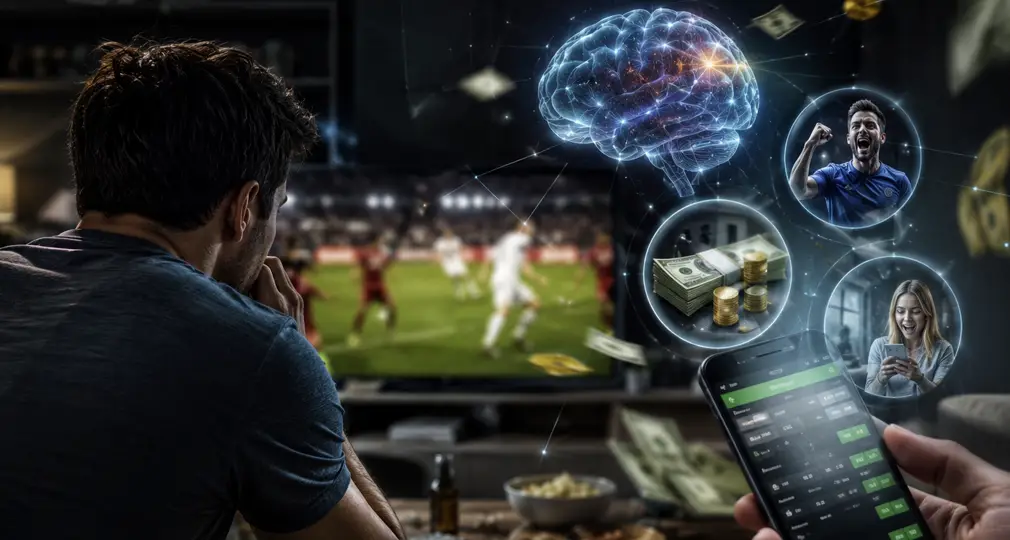
Modern betting advertising is built less around direct product promotion and more around behavioral psychology. Gambling operators compete in an environment where users see thousands of marketing messages daily across social media, streaming platforms, sports broadcasts, and mobile applications. Because of this overload, sportsbooks increasingly use emotional and cognitive triggers designed to accelerate impulsive decisions. Research from behavioral economics shows that emotionally charged advertising activates faster decision-making mechanisms than purely rational messaging. In gambling, this effect becomes especially powerful because betting naturally combines risk, reward anticipation, and emotional excitement.
Traditionally, bookmakers promoted odds and sporting events themselves, but the market evolved significantly after mobile betting expansion. Operators now focus heavily on urgency, social proof, exclusivity, and personalized engagement. Advanced algorithms analyze user behavior patterns, session timing, favorite sports, and even emotional responses to previous campaigns. This allows companies to optimize advertising pressure with remarkable precision. As a result, betting advertising increasingly resembles psychological targeting systems used in social media and e-commerce ecosystems.
Fear of Missing Out (FOMO) as a Core Betting Trigger
Psychologically, fear of missing out remains one of the strongest conversion mechanisms in gambling marketing. Bettors are constantly exposed to messages implying that a unique opportunity exists only temporarily. Promotions such as “boosted odds for the next 30 minutes” or “exclusive match offer available today” create artificial scarcity designed to bypass analytical thinking. Studies in consumer psychology consistently show that limited-time offers increase impulsive spending behavior, especially in emotionally stimulating environments. Sports betting platforms actively exploit this tendency during major tournaments and live matches.
Commercially, FOMO campaigns became significantly more aggressive after the growth of mobile betting applications. Push notifications now deliver real-time promotional messages directly during sporting events when emotional engagement is already elevated. During events like the FIFA World Cup or the Super Bowl, sportsbooks may launch hundreds of micro-promotions daily targeting live betting activity. This creates continuous urgency cycles encouraging repeated wagers. Behavioral analysts warn that constant urgency messaging can weaken self-control and increase compulsive betting tendencies over time.
Common FOMO mechanisms in betting advertising include:
- limited-time odds boosts during live matches
- countdown timers attached to promotions
- “exclusive” VIP betting opportunities
- notifications suggesting mass user participation
- temporary cashback or free bet campaigns
These techniques are specifically designed to accelerate decision-making speed and reduce hesitation.
Social Proof and Influencer Culture in Gambling
Social influence became dramatically more important after the integration of betting content into streaming culture and sports media ecosystems. Users are far more likely to trust betting products when they see public figures, influencers, or large online communities engaging with them. Sportsbooks actively cooperate with athletes, streamers, and celebrities because social validation reduces psychological resistance toward gambling products. Research in digital marketing demonstrates that users frequently interpret popularity as evidence of legitimacy and safety. This mechanism is especially effective among younger audiences accustomed to influencer-driven consumer behavior.
Meanwhile, social proof extends beyond celebrity endorsement alone. Betting platforms increasingly display statistics such as “85% of users backed this outcome” or “most popular bet today” to create herd behavior dynamics. Such messaging subtly pressures users into following perceived majority opinion instead of relying on independent analysis. Streaming platforms like Twitch and Kick amplified this effect because gambling activity became highly visible and community-driven. Gambling therefore shifts psychologically from private wagering into participatory social entertainment.
| Psychological Trigger | Purpose | Behavioral Effect |
|---|---|---|
| FOMO | Create urgency | Faster impulsive betting |
| Social proof | Normalize gambling behavior | Reduced skepticism |
| Personalization | Increase emotional relevance | Higher engagement |
| Reward anticipation | Stimulate dopamine response | Repeated wagering |
| Gamification | Extend session duration | Increased retention |
Importantly, these triggers are rarely used separately. Modern betting campaigns usually combine multiple behavioral techniques simultaneously to maximize user engagement.
Dopamine and Reward Anticipation
Neurologically, sports betting advertising often targets anticipation rather than winning itself. Brain imaging studies show that dopamine activity increases strongly during reward expectation phases, especially under uncertainty conditions. Gambling operators exploit this biological response by emphasizing potential excitement, near-wins, and emotional intensity rather than statistical reality. Phrases like “biggest comeback,” “life-changing odds,” or “last-minute miracle” stimulate emotional imagination before any wager occurs. This creates psychological momentum encouraging users to seek emotional stimulation repeatedly.
Scientifically, uncertainty plays a crucial role in gambling-related dopamine activation. Variable reward systems — where outcomes remain unpredictable — are known to produce stronger engagement patterns than guaranteed rewards. Betting advertisements frequently highlight dramatic sporting narratives because emotional unpredictability increases cognitive involvement. Mobile betting interfaces intensify this process through rapid notifications, flashing updates, and instant wagering opportunities. Combined together, these elements create a highly stimulating environment optimized for repeated engagement behavior.
Key emotional triggers connected to reward anticipation include:
- dramatic storytelling around sporting events
- visualization of large potential winnings
- emphasis on emotional excitement instead of probability
- near-win narratives and comeback scenarios
- constant live betting stimulation during matches
Behavioral researchers increasingly compare these engagement systems to mechanisms used in social media and gaming addiction models.

Gamification and Behavioral Retention
Structurally, modern sportsbooks increasingly resemble mobile games rather than traditional betting platforms. Gamification systems introduce missions, loyalty progression, achievements, badges, and leaderboard mechanics to encourage continuous interaction. Instead of placing occasional bets, users are incentivized to maintain daily activity streaks and complete engagement tasks. Market reports show that platforms using strong gamification mechanics often achieve significantly higher retention rates than simpler betting interfaces. This transforms gambling from isolated wagering into persistent digital engagement ecosystems.
Technologically, gamification works because it creates secondary reward loops beyond direct financial outcomes. Even when users lose bets, progression systems and bonus mechanics still provide psychological reinforcement. Betting operators understand that engagement duration often matters more commercially than individual wager outcomes. This is particularly visible in live betting environments where users may remain active for hours across multiple micro-events. Critics argue that such systems intentionally blur the line between entertainment gaming and high-risk financial gambling.
| Gamification Feature | Intended User Reaction | Risk Factor |
|---|---|---|
| Loyalty levels | Long-term retention | Increased gambling frequency |
| Daily missions | Habit formation | Compulsive behavior risk |
| Achievement badges | Psychological reward | Reduced spending awareness |
| Leaderboards | Competitive pressure | Escalating wager size |
| XP progression systems | Continuous engagement | Session prolongation |
Because these systems mimic mechanics used in video games, younger audiences often adapt to them extremely quickly.
Personalized Advertising and AI Targeting
Artificial intelligence fundamentally changed betting advertising over the last five years. Operators now process enormous quantities of behavioral data including betting history, favorite teams, active hours, and promotional response patterns. AI-driven systems can predict which users are more likely to respond to specific emotional triggers or bonus types. Personalized campaigns therefore become significantly more effective than generic advertising because they target individual behavioral weaknesses directly. Some platforms reportedly adjust notification timing according to user engagement rhythms and betting habits.
Ethically, personalized gambling advertising raises serious concerns among regulators and psychologists. Critics argue that behavioral targeting systems may disproportionately affect vulnerable users struggling with impulse control or gambling addiction risks. Several European regulators already introduced restrictions limiting aggressive personalized gambling promotions. Nevertheless, AI-driven targeting continues expanding because it substantially improves conversion efficiency and retention metrics. Industry analysts expect predictive behavioral advertising to become even more sophisticated by 2030.
Major concerns surrounding AI-targeted betting advertising include:
- behavioral profiling of vulnerable users
- hyper-personalized emotional manipulation
- increased exposure during high-risk periods
- automated optimization of compulsive engagement
- reduced transparency in targeting algorithms
These issues are becoming central topics in modern gambling regulation debates worldwide.
Regulation and Ethical Challenges
Legally, governments are increasingly attempting to restrict psychologically aggressive betting advertising practices. Countries such as the United Kingdom, Spain, Italy, and the Netherlands already implemented partial limitations on celebrity endorsements, bonus advertising, and sports broadcast integration. Regulators are especially concerned about gambling exposure among young adults and minors through streaming platforms and social media ecosystems. Public health researchers argue that modern betting advertising often normalizes gambling behavior while minimizing discussion of financial risk. This creates long-term concerns about rising addiction rates and financial harm.
Socially, the debate surrounding betting marketing continues intensifying as gambling becomes more digitally integrated into everyday entertainment. Critics claim that sports broadcasts increasingly blur the distinction between sports fandom and constant wagering opportunities. At the same time, gambling operators argue that advertising restrictions primarily strengthen black-market platforms operating outside regulated systems. This tension creates a complicated regulatory environment balancing consumer protection with market competition. The psychological sophistication of modern betting advertising ensures that this debate will likely continue for many years.
Ultimately, the psychology of sports betting advertising relies heavily on emotional triggers, behavioral science, and technological personalization. Modern sportsbooks use urgency, social proof, reward anticipation, gamification, and AI targeting to maximize user engagement and betting frequency. These systems are increasingly sophisticated, combining neuroscience, data analytics, and digital entertainment mechanics into one integrated marketing structure. While such strategies may improve user retention and operator revenue, they also raise significant ethical and regulatory concerns regarding manipulation and addiction risks. As online gambling continues evolving, understanding the psychological architecture behind betting advertising becomes increasingly important for both users and regulators.
Read more: Cash advance at casino with debit card