

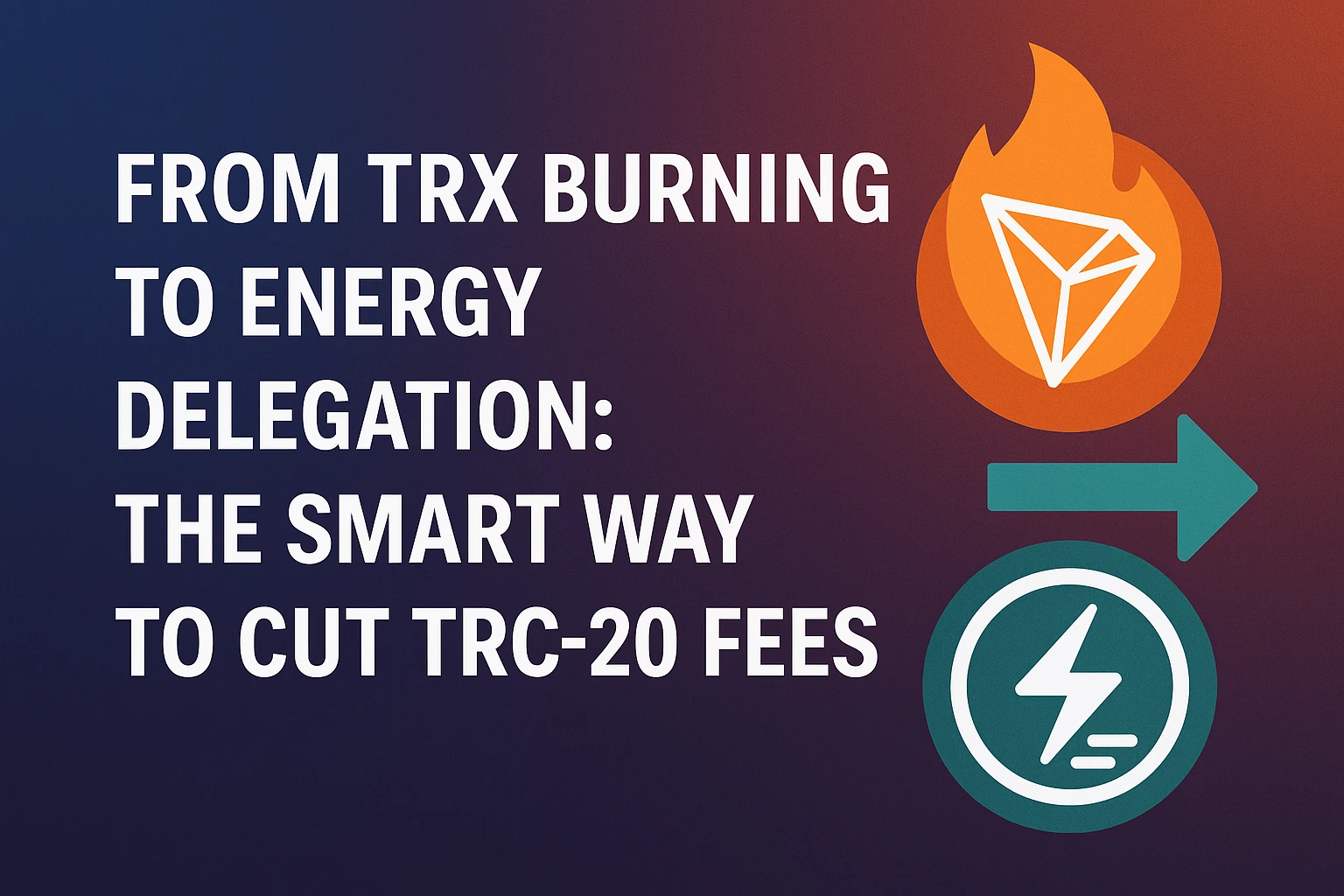
If you’ve used the TRON network for any length of time, you’ve probably felt the sting of TRC-20 token fees. On paper TRON is “cheap,” but when you interact with DeFi protocols, DEXes, stablecoins, or gambling platforms many times a day, those little deductions add up. For active users, the classic solution has usually been simple: keep some TRX in your wallet and accept that a chunk of it will get burned on transaction fees over time.
However, the TRON ecosystem offers a smarter alternative that many users either overlook or misunderstand: energy delegation. Instead of constantly burning TRX on fees, you can lock TRX once, convert it into a resource (Energy), and then use or even rent that Energy to cover your TRC-20 interactions. The difference over weeks or months can be huge — especially if you’re an active trader, a bot operator, or you run multiple wallets.
Why TRX Burning Is the “Lazy Tax” of TRON
On TRON, every transaction consumes network resources: Bandwidth and Energy. Basic transfers usually use Bandwidth, which is relatively cheap. But smart contract interactions — like TRC-20 token transfers, swaps, staking, farming, borrowing, and lending — consume Energy.
If your wallet doesn’t have enough Energy, the network takes the required cost directly from your TRX balance and burns it. That means:
- Your TRX balance slowly shrinks over time.
- Heavy users can end up spending more on fees than they realize.
- You get nothing in return: that TRX is gone for good.
This “pay as you go and forget about it” model is easy… but financially inefficient. It’s like paying for mobile data at a ridiculous per-MB rate instead of just getting a plan.
Enter Energy Delegation: Prepay Once, Save for a Long Time
TRON’s resource model lets you stake (freeze) TRX for Energy. When you stake TRX, you’re not spending it — you’re just locking it for a period, and in exchange you receive Energy that you can spend on smart contract operations. When you no longer need the Energy, you can unfreeze your TRX.
The next level is energy delegation. Instead of just staking in your own wallet, you can use specialized platforms that optimize this process, renting you Energy or managing it at scale so you don’t have to constantly micromanage freezing, unfreezing, and resource balancing. A typical scenario is: you keep your TRX, obtain cost-effective Energy, and use that Energy to power your TRC-20 operations with far lower effective fees. Many users discover they can dramatically reduce the cost per transaction by turning to delegated tron energy solutions such as tron energy, which help automate and optimize this resource approach instead of just burning TRX directly on every contract call.
In other words, you’re shifting from reactive spending (TRX burned per transaction) to proactive resource management (acquiring Energy once and using it many times).
How Energy Delegation Works in Practice
Let’s break it down in simple steps:
- You lock TRX (directly or via a platform) to get Energy.
- Energy is allocated to your address (or delegated to it), which then powers contract calls.
- When you make a TRC-20 transaction, Energy is consumed instead of TRX being burned.
- If you go through a third-party energy service, they may:
- Pool TRX from many users,
- Manage staking and optimization,
- Provide you Energy at a predictable rate, often cheaper than raw fees.
From your point of view, it feels like you are simply paying less for the same actions — especially when you transact frequently.
Comparing TRX Burning vs Energy Delegation
Let’s compare the two approaches the way a business would look at costs.
1. Cost predictability
- TRX burning: Fees fluctuate based on network load and contract complexity. It’s hard to budget.
- Energy delegation: You know roughly how much Energy you have and how many operations it can support. It’s easier to estimate your costs over a week or month.
2. Capital efficiency
- TRX burning: Every fee you pay is gone; you’re constantly losing capital.
- Energy delegation: You lock TRX but keep ownership. In many models, once you’re done, you can unlock it again. Your “fee” is effectively the opportunity cost during staking and any service fee you pay.
3. High-frequency usage
- TRX burning: Costs scale linearly with each interaction. Heavy users are punished the most.
- Energy delegation: The more transactions you perform, the more value you squeeze out of your Energy allocation, effectively lowering the cost per transaction.
4. Flexibility
- TRX burning: Very simple, but not flexible. You pay whatever the network demands at that moment.
- Energy delegation: Slightly more setup, but you can scale up or down, delegate to different addresses, or adjust based on how active you are.
Who Benefits the Most From Energy Delegation?
While anyone using TRC-20 tokens can benefit from lower fees, some profiles gain massively:
- Arbitrage and trading bot operators who run dozens or hundreds of transactions per day.
- Heavy DeFi users constantly swapping, staking, adding/removing liquidity.
- USDT/Stablecoin “cashiers” handling frequent deposits and withdrawals.
- NFT and GameFi players who interact with contracts multiple times per session.
- Businesses and payment gateways processing many on-chain payments on TRON.
If you fit any of these categories, continuing to rely on pure TRX burning is basically donating money to the network that you don’t have to.
Common Myths About Energy Delegation
Despite the advantages, there are still misconceptions that hold people back.
“It’s only for advanced users.”
Not really. While manual staking and resource tuning might feel technical, modern platforms abstract most of this away. You can treat it like buying a cheaper, bulk data package rather than paying per megabyte.
“I’ll lose my TRX if I stake it.”
Staking TRX for resources doesn’t mean you’re spending it. You are locking it and can unfreeze it later (subject to TRON’s rules). You’re trading short-term liquidity for long-term fee savings.
“I don’t transact enough to make it worthwhile.”
That might be true if you only use TRON once in a while. But many people underestimate their activity. If you’re using the network weekly or daily — especially with complex contracts — it’s worth at least running the math.
Practical Tips to Optimize Your TRC-20 Costs
Here are some simple strategies you can adopt right away:
- Track how much TRX you actually burn. Many users never look. Check your wallet history over a week or month and roughly estimate the TRX lost to fees.
- Calculate your “break-even” point. Compare how much TRX you burn in a typical month versus what it would cost to acquire Energy via delegation. If your fee burn is equal to or higher than the cost of delegated Energy, you’re leaving money on the table.
- Separate wallets by usage. If you have a trading wallet and a “storage” wallet, consider delegating Energy primarily to the active one. That way your cold funds stay untouched and safe.
- Monitor network conditions. Even with Energy, extremely busy periods can change costs and consumption. Understanding when the network is quiet can stretch your Energy further.
- Use analytics or dashboards if available. Some platforms give you statistics on how much Energy you’ve consumed, how many transactions it funded, and what your effective cost per transaction is. That’s incredibly helpful for optimization.
The Strategic Mindset: Think Like an Infrastructure User, Not a Tourist
The biggest shift you can make is mental: stop thinking of TRON as a place where you randomly pay a fee each time you show up, and start thinking of it as infrastructure you actively use and optimize.
Tourists pay whatever the airport charges for bottled water. Locals know where the supermarket is. In the same way, casual users may be fine burning a bit of TRX here and there. But if you’re using TRON as part of a business, a side hustle, or intensive personal strategy, then energy delegation is the “local price” of the network.
Instead of constantly watching your TRX balance erode, you can:
- Allocate a portion as long-term “infrastructure capital”
- Use it to power your smart contract usage via Energy
- Keep your working capital intact instead of burning it one transaction at a time
Conclusion: The Smart Way Forward on TRON
TRON gives you a choice: keep paying invisible “tourist tax” via TRX burning, or learn to use the network’s resource model to your advantage through Energy and delegation.
For light, occasional users, burning a few TRX per month might not matter. But if you’re moving serious volume, running bots, interacting with DeFi, or managing many wallets, sticking to TRX burning is one of the most expensive mistakes you can make.
By understanding and leveraging Energy delegation — and using specialized tron energy services instead of blindly paying transaction fees — you can transform TRC-20 operations from an ongoing drain into a predictable, optimized cost of doing business on TRON.
Read More: The Biggest NFT Scandals in the History