



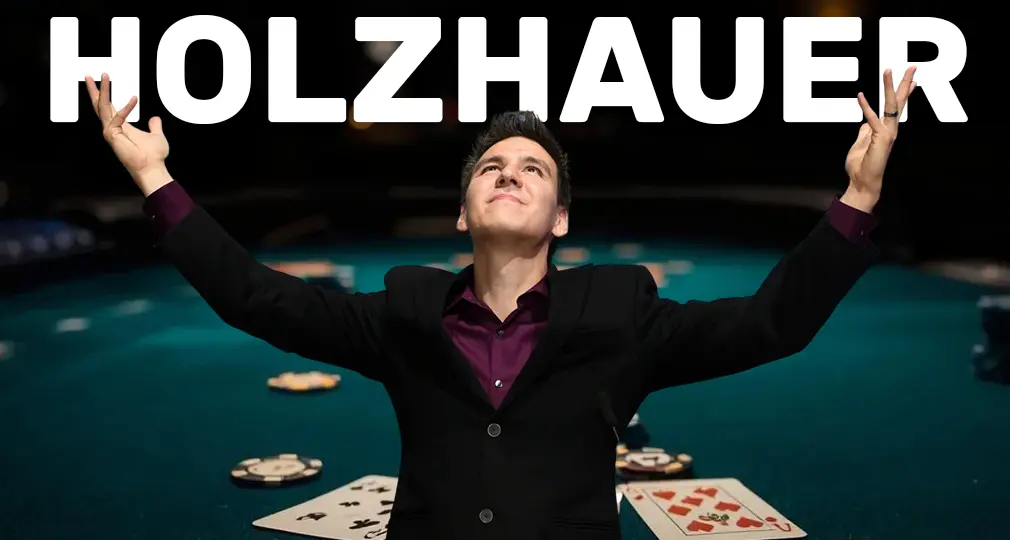
James Holzhauer became globally famous not because of traditional casino gambling, but because of his extraordinary analytical thinking and aggressive probability-based decision-making. Before becoming a television phenomenon, Holzhauer had already built a reputation in professional sports betting circles as a disciplined and mathematically oriented bettor. His later success on television simply exposed his strategic mindset to a mainstream audience. Unlike many gamblers driven by emotion or intuition, Holzhauer approached every decision as a statistical problem that could be optimized. This combination of intelligence, risk tolerance, and preparation made him one of the most recognizable gambling-related personalities of the modern era.
Born in Illinois in 1984, James Holzhauer demonstrated exceptional mathematical abilities from a young age. He studied mathematics at university level and quickly developed an interest in probability theory, game optimization, and betting markets. His academic background later became a foundation for both his sports betting career and television success. Long before mainstream fame, he spent years studying bookmaker behavior, line inefficiencies, and bankroll management techniques. This deep analytical preparation separated him from casual gamblers and positioned him closer to quantitative betting professionals.
How Holzhauer Became Famous
The turning point in Holzhauer’s public career came through the legendary TV show Jeopardy!. While many contestants focused on conservative gameplay, Holzhauer introduced an aggressive strategy inspired directly by sports betting logic and expected value calculations. He consistently targeted high-value clues early, maximized Daily Double opportunities, and used large wagers to pressure opponents psychologically. His style looked risky to casual viewers, but mathematically it was highly rational and optimized for maximizing long-term winning probability. This transformed him from a strong contestant into a cultural phenomenon.
During his historic run, Holzhauer broke multiple earnings records and dominated competitors through speed, preparation, and strategic aggression. What fascinated analysts was not only his knowledge base, but the efficiency of his decision-making process under pressure. He treated the game almost like a betting market where value opportunities had to be exploited immediately. Media coverage quickly connected his success to his background in professional sports betting. As a result, Holzhauer became known not just as a trivia champion, but as an example of how gambling mathematics can be applied outside casinos and sportsbooks.
Core Elements of His Strategy
One reason James Holzhauer attracted so much attention was his systematic approach to risk. Instead of avoiding variance, he embraced calculated aggression whenever probabilities justified it. This mindset is common among professional bettors but rare in public competition formats where fear of losing often dominates decision-making.
The key principles associated with his strategy include:
- maximizing expected value instead of minimizing short-term risk
- using aggression to create psychological pressure on opponents
- relying on preparation and data rather than intuition
- understanding probability better than average competitors
These concepts helped him outperform players who had comparable knowledge but weaker strategic structure.

Connection Between Gambling and Decision-Making
Holzhauer’s sports betting experience strongly influenced the way he analyzed competitive situations. Professional bettors constantly evaluate probability, market inefficiencies, and risk-reward ratios, and Holzhauer applied these same principles in televised competition. Rather than treating gambling as entertainment alone, he approached it as a long-term analytical process. This perspective helped him remain emotionally controlled even during high-pressure moments involving massive financial stakes. His calm behavior reflected years of experience dealing with variance in betting markets.
Unlike stereotypical gamblers, Holzhauer rarely emphasized luck when discussing success. Instead, he consistently focused on preparation, statistical edges, and disciplined execution. This made him especially respected among analytical bettors and quantitative gambling communities. Many professionals viewed his television dominance as proof that probability-based thinking can outperform traditional conservative decision-making. His success also helped popularize discussions around expected value and strategic aggression among mainstream audiences.
James Holzhauer’s Career and Public Impact
| Area | Why It Became Important |
|---|---|
| Sports betting | Built his analytical foundation |
| Jeopardy! success | Made him internationally famous |
| Probability-based strategy | Changed public perception of gameplay |
| Media appearances | Expanded his influence beyond gambling |
| Risk management philosophy | Inspired analytical bettors |
Holzhauer’s influence extends beyond entertainment because he demonstrated how mathematical thinking can consistently outperform emotional decision-making. His approach attracted attention not only from gambling communities, but also from economists, statisticians, and behavioral analysts. Many experts viewed his success as a real-world example of applied game theory under pressure. Unlike short-lived media personalities, his reputation remained strong because his results were backed by visible strategic logic. This credibility helped him maintain long-term relevance even after his television peak.
Why His Story Matters in Gambling
The gambling industry often promotes excitement, instinct, and emotional narratives, but Holzhauer represents the opposite approach. His career highlights the importance of preparation, discipline, and probabilistic thinking in environments dominated by uncertainty. While many gamblers chase action impulsively, Holzhauer built systems designed around long-term edge and controlled aggression. This difference is what separates professional-level thinking from recreational gambling behavior. His story demonstrates that successful betting is usually closer to analytics and finance than to luck-driven entertainment.
Another reason his story matters is because it changed public perception of gamblers themselves. Many people associate gambling with recklessness, but Holzhauer showed that analytical betting can resemble quantitative investing or strategic trading. His calm public image and intelligent explanations helped legitimize discussions around probability theory and expected value. As gambling markets become increasingly data-driven, his philosophy feels even more relevant in 2026 than it did during his original rise to fame. Modern bettors increasingly rely on models, statistics, and optimization — areas where Holzhauer excelled naturally.
James Holzhauer became famous because he combined mathematical intelligence, betting discipline, and strategic aggression in a way rarely seen in public competition. His success on Jeopardy! was not simply about knowledge, but about understanding probabilities better than his opponents. By applying professional gambling principles to a mainstream format, he changed how millions of people viewed risk and decision-making. His story continues to inspire bettors, analysts, and strategic thinkers across multiple industries. More importantly, he proved that controlled aggression supported by mathematics can outperform fear-based conservative play over the long run.
Read more: Best Gambling Payment Providers