



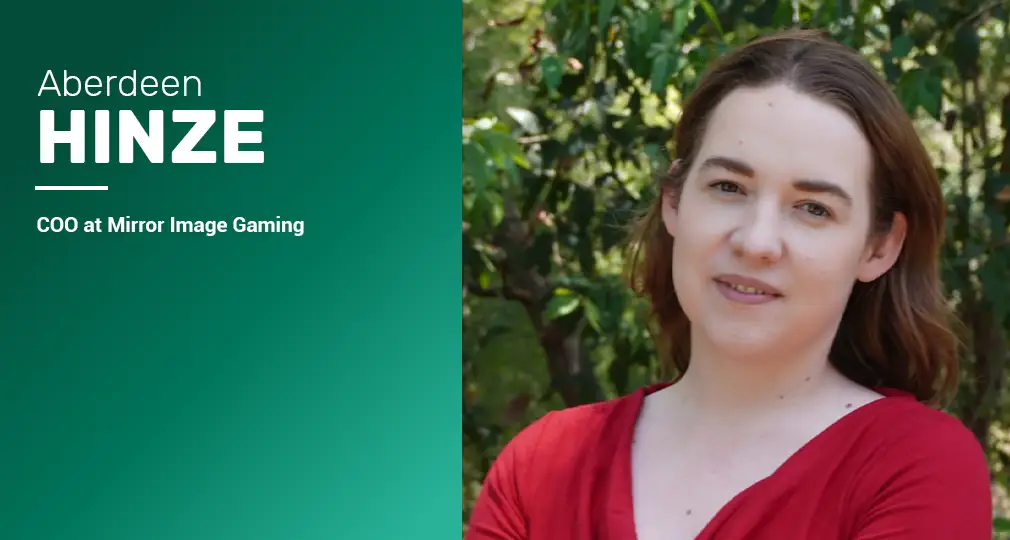
Mirror Image Gaming designs for time well spent, building gambling worlds players explore, not spins they rush through. COO Aberdeen Hinze explains how a game-first mindset, specialist partners, and low-to-medium volatility design are creating longer more sustainable play experiences.
What specific background do the founders bring to the table that allows you to pivot away from traditional slot design?
The Mirror Image Gaming founding team consists of Gray Wagner (CEO), Jordie Wagner (CTO) and myself, Aberdeen Hinze (COO). We also have a small team of game developers from PC and console gaming backgrounds bringing to life hybrid gaming experiences. This unique team set up has allowed us to adopt a “gamer first” mindset and to take a creative direction borrowed from indie game development, prioritising physic-based mechanics, narrative and game feel. Our leadership team puts real importance on partnering with high performing, proven technical partners and engines, which allows us to focus solely on creating great games that players love, but which also fit within regulated gambling frameworks. It’s this foundation that we’ve used to pioneer the Burst Games we are building our reputation for differentiation on.
You’ve partnered with The Fortune Engine. How does this collaboration act as a “force multiplier” for Mirror Image Gaming?
It allows us to focus on creativity. By outsourcing the “plumbing” – game math, certification, backend and distribution – our team can focus 100% on gameplay and character design. We are able to undertake rapid game prototyping, using pre-built game templates and math solving tools. We can quickly validate unique mechanics (like gravity and collision) that would otherwise take years to build from scratch and come with a higher level of internal business risk – players are always cautious when trying something totally new. Many of the mechanics we prototype may never reach the market — and that’s intentional. The speed of the tool allows us to ‘fail fast’ and focus our energy on concepts that we know have legs.
You’ve pioneered the “Burst” category. While the definition of a Burst Game seems relatively broad, what are the three core pillars that put a Mirror Image game into this category?
As you say, we see this as being a broad category of games, but we describe burst games as a new gambling genre inspired by the golden era of flash games and 80s arcade games — playful, experimental, physics-driven experiences where outcomes unfold through motion, interaction, and layered mechanics rather than a single static spin. They are playful and experimental by design.
Burst games are designed as self-contained worlds. Each game establishes its own rules, physics, and behaviours, inviting players to explore different outcomes and experiences beyond traditional payline wins. Players aren’t waiting for a result, they are exploring the world and experiences within it. Wins may come from chain reactions, survival, progression through layers, or reaching specific states within the game world. This shifts the experience from chasing a single win line outcome to chasing moments, creating tension, anticipation, and variety within each session.
We’ve all played games like Pac-Man, Donkey Kong or Minecraft and thought — this mechanic is compelling, this world is engaging, the enjoyment in uncovering new experiences within the world is real. But translating those experiences into gambling has, until now, been really hard to achieve. This is where The Fortune Engine partnership has been so important for MIG, and now this technological and mathematical gap begins to close. It allows our developers to ask ‘what if?’ questions — what if Galaga was a gambling experience? What if a sandbox-style world encouraged players to chase moments, survival, or reactions rather than paylines?
Once technical constraints are removed, we are only limited by the strength of our creative minds.
In games like Royal Drop and Drop the Boss, the mechanics look very different from traditional online slots—but are they still grounded in a rigorous gambling math model underneath?
Gravity, collision, and a map ready for exploring sit at the core of the experience for Royal Drop and Drop the Boss. I will walk you through our game development lifecycle using The Fortune Engine, which allows us to translate these unconventional mechanics into a compliant, controllable math framework.
Our process starts creatively rather than mathematically. We begin by building our ‘world’ and ‘characters’. From here we identify the key events that define the game world — moments like the Queen being struck by a storm cloud, entering the bus multiplier feature, or landing safely in her palace. These events form the emotional and experiential backbone of the game. From there, within The Fortune Engine we create a game math blueprint. This is a first-pass estimate of how often we want each event to occur during play. It’s not about paylines or symbols; it’s about experiences, moments, and progression through the world.
Once the blueprint is established, we build the full math model within the engine. This is where The Fortune Engine really comes into its own. It constructs the underlying game logic and provides a visual interface that allows us to balance, tune, and test the game across multiple RTP versions in real time.
Crucially, we can play the new game and if an event doesn’t feel like it’s occurring often enough — or feels too frequent — we can immediately adjust the math and test again. That tight feedback loop allows us to focus on player experience rather than being locked into static models. If it feels good to our game devs, it will feel good for our audiences.
Our philosophy is to build low to medium volatility games that players can trust. It’s not purely about chasing big wins; it’s about sustainable play, spending time in a world, and engaging with its characters, events, and landing zones. We want players to feel like they’re learning a space, forming preferences, and chasing experiences — not just waiting for a spin to resolve.
Why do you believe your unique mechanics resonate so well with Millennial and Gen Z audiences?
It comes down to the arcade familiarity of our games. These are players who grew up with Flash games and mobile titles so understand physics-based challenges. On the flip side, spinning the reels feels aimless and repetitive. Burst Games are perfect for social interaction and streaming, with their satirical themes and chaotic, high-intensity rounds ideal for social platforms and streaming lobbies. They also provide transparent tension – the player can see why they won or lost based on the character’s descent, rather than just waiting for a random number to appear on the screen as is the case with standard slots and table games.
Your games feature very distinct, often satirical characters. How important is humour and narrative in a genre usually focused on pure math?
Traditional slots often rely on exhausted themes such as ancient Egypt, gems, Joker, fruits, etc but we use satire to create an immediate emotional resonance and “meme-ability” that ensures they stand out in any online casino lobby. In addition, by giving players characters like Queen Lizzie or a corporate “Boss” styled on Donald Trump, we turn each betting round into a mini-story – players aren’t just betting on a number, they’re rooting for (or against) a character. Satire also allows us to tap into the zeitgeist, making our games feel current to a Gen Z audience that values irony and sharp social commentary.
You’ve hinted at multiplayer gambling formats using Burst as the foundation. How do you see this evolving through Mirror Image Gaming?
Our Burst games are fundamentally world-driven, which we believe naturally lends itself to multiplayer experiences over time. Rather than designing isolated rounds, we focus on building spaces with rules, resources, and objectives — an approach that translates well to shared play.
If you look at games like Minecraft, the appeal comes from multiple players inhabiting the same world, gathering resources, undertaking challenges, and shaping outcomes together. We see clear parallels in how Burst games could evolve — where friends can enter the same environment, pursue shared or individual goals, and experience gambling mechanics as part of a broader interactive system rather than a standalone spin.
It’s still early days, but we’re already seeing early signals of this direction in the market. Experiences like DamnBruh’s multiplayer worm game demonstrate how player choice, shared interaction, and gambling elements can coexist in a way that feels intuitive and engaging.
As technology infrastructure continues to mature, we expect casino lobbies to begin supporting these kinds of multiplayer experiences. When that happens, Mirror Image Gaming intends to be at the forefront — creating rich, enjoyable gambling worlds that feel closer to modern video games than traditional casino formats.