



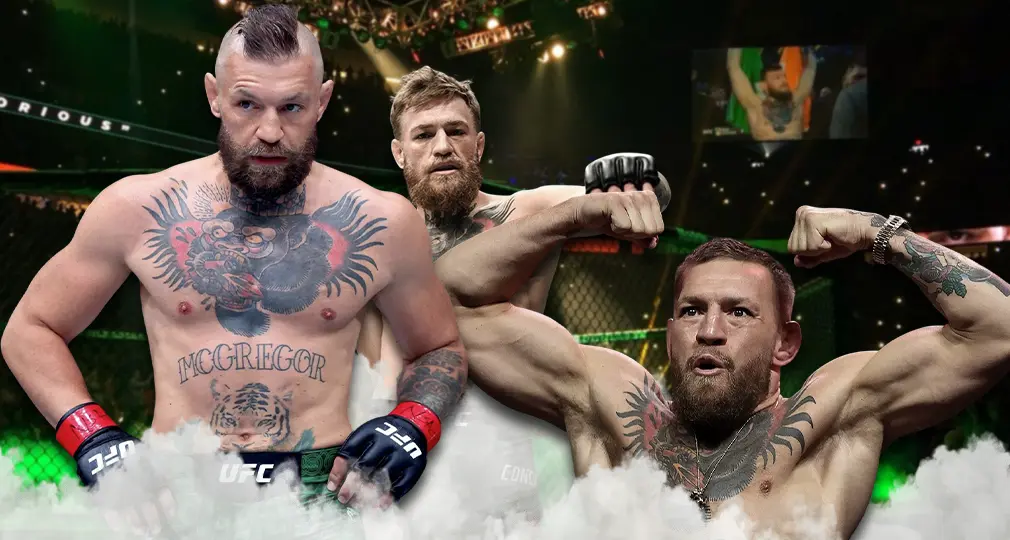
Look, Conor McGregor never treated a fight prediction like a quiet press-conference formality. He turned it into part threat, part sales pitch and part betting market, which is pretty wild when you remember that real money followed every sentence. Well, actually, that was the trick: he made fans feel as if they knew the ending before the cage door closed. Sometimes “Mystic Mac” nailed it almost to the second, while other nights the prediction crashed hard and took thousands of betting slips with it.
Why McGregor’s Predictions Became Bigger Than Trash Talk
Honestly, most fighters say they expect to win, then give us the usual line about respecting a dangerous opponent. McGregor preferred exact rounds, exact methods and the occasional outrageous financial challenge, so every interview created another market to discuss. For example, calling a first-round knockout is far more useful to a bettor than simply saying, “I feel good.” That confidence was entertaining, this is true, but it also pushed casual money toward short-finish props and sometimes moved the main betting line itself.
- He regularly predicted a specific finishing round.
- His preferred call was usually a knockout or technical knockout.
- Public confidence encouraged bets on early-round and method-of-victory markets.
- His popularity could shorten his odds even when the matchup remained difficult.
- Several predictions were accurate, but some of the loudest ones failed badly.
Conor McGregor’s Record and Key Numbers
Numbers tell a rougher story than the highlight reels, and that is where a serious betting discussion should begin. McGregor currently owns a professional MMA record of 22 wins and 7 losses, with 19 victories by knockout or technical knockout, one by submission and two by decision.[1] That gives him an 86.4% knockout rate across his wins and a 90.9% overall finishing rate, which is honestly ridiculous for a fighter who spent most of his elite career around featherweight and lightweight. His UFC record stands at 10-5, so the peak was brilliant, although the later results have been far less friendly to anyone blindly backing the famous name.
| Career category | Current figure | What it means for bettors |
|---|---|---|
| Professional MMA record | 22-7 | Strong career record, but recent defeats matter more than old championship wins |
| UFC record | 10-5 | One loss in every three UFC appearances |
| KO/TKO victories | 19 | Early-finish markets have historically matched his strongest weapon |
| Submission victories | 1 | A McGregor submission prop has rarely been the natural angle |
| Decision victories | 2 | His best performances usually produce damage rather than quiet scorecards |
| Win finishing rate | 90.9% | Twenty of his twenty-two wins ended before the final bell |
| Age | 38 | Recovery, reactions and cardio now deserve more weight in any model |
The Famous Predictions: Hits, Near Misses and One Proper Disaster
Back in his fastest rise, McGregor was not throwing random guesses at the wall. He had a clear read on his own left hand, his opponents’ reactions under pressure and the amount of time he needed to establish range. Besides, between us, a few of these calls were so accurate that the “Mystic Mac” nickname practically wrote itself. Others missed the round but caught the overall shape of the fight, while the Nate Diaz prediction aged like milk left beside a radiator.[3]
| Opponent | McGregor’s public call | Actual result | Prediction grade |
|---|---|---|---|
| Diego Brandao | First-round finish | McGregor won by TKO at 4:05 of Round 1 | Spot on |
| Dustin Poirier I | First-round knockout | McGregor won by TKO at 1:46 of Round 1 | Spot on |
| Chad Mendes | Mendes unconscious within four minutes of Round 1; McGregor also proposed a huge bet on a finish by the end of Round 2 | McGregor won by TKO at 4:57 of Round 2 | Wrong first call, right wider finish window |
| José Aldo | Aldo finished within four minutes of Round 1 | McGregor won by knockout after 13 seconds | Even faster than predicted |
| Dennis Siver | Finish within two minutes | McGregor won by TKO at 1:54 of Round 2 | Right numbers, wrong round |
| Eddie Alvarez | First-round knockout | McGregor won by TKO at 3:04 of Round 2 | Right winner and method, wrong round |
| Nate Diaz I | First-round knockout | Diaz won by submission at 4:12 of Round 2 | Total miss |
The Chad Mendes Bet That Sounded Completely Mad
Markets love a dramatic story, and McGregor supplied one before UFC 189 by proposing a multimillion-dollar wager on himself. Reports from the UFC build-up described a proposed bet worth roughly $3.5 million that he would finish Chad Mendes before the end of the second round.[3] The wager was not presented as an ordinary accepted sportsbook ticket, so treating it like a settled public bet would be wrong, but the prediction itself landed with three seconds left in Round 2. That is crazy, and I still would not recommend copying the stake size unless losing several million feels like misplacing loose change.
Historic McGregor Odds and What the Market Believed
Take the betting line away from the noise and you can see how sharply public opinion changed from fight to fight. McGregor was close to a pick’em price against Aldo, became an enormous favorite against Nate Diaz and Dustin Poirier, then later entered major fights as an underdog.[4] Anyway, the scary part is that several of his worst betting results came when the market priced him as almost unbeatable. Odds vary between sportsbooks and moments in the market, so the figures below use tracked closing ranges rather than pretending one number existed everywhere.
| Fight | Approximate tracked McGregor closing price | Implied probability | Result |
|---|---|---|---|
| José Aldo, UFC 194 | Around -105 | 51.2% | Won by KO, Round 1 |
| Nate Diaz I, UFC 196 | Around -425 | 81.0% | Lost by submission, Round 2 |
| Eddie Alvarez, UFC 205 | Around -160 | 61.5% | Won by TKO, Round 2 |
| Khabib Nurmagomedov, UFC 229 | Around +169 | 37.2% | Lost by submission, Round 4 |
| Dustin Poirier II, UFC 257 | Around -290 | 74.4% | Lost by TKO, Round 2 |
| Dustin Poirier III, UFC 264 | Around +115 | 46.5% | Lost by doctor stoppage, Round 1 |
| Max Holloway II, UFC 329 | Approximately +200 to +240 | 29.4%–33.3% | Lost by injury TKO at 1:09 of Round 1 |
How American Odds Translate Into Real Probability
Against all the shouting online, odds are simply prices, not sacred predictions carved into stone. A negative line such as -160 means risking 160 units to win 100, and its basic implied probability is 160 divided by 260, or 61.5%. A positive line such as +200 returns 200 units of profit for every 100 risked, which represents an implied probability of 33.3%. Keep in mind that bookmaker margin is still inside the market, so adding both fighters’ implied probabilities usually gives you more than 100%.
| Odds format | Probability formula | Example | Implied probability |
|---|---|---|---|
| Negative American odds | Odds ÷ (odds + 100) | -290 | 74.4% |
| Positive American odds | 100 ÷ (odds + 100) | +169 | 37.2% |
| Decimal odds | 1 ÷ decimal price | 3.00 | 33.3% |
When “Mystic Mac” Was Actually Useful for Bettors
Against Brandao, Poirier and Aldo, the early-finish logic had real technical support rather than pure theatre. McGregor controlled distance with a long southpaw stance, drew opponents onto the left hand and punished aggressive entries before they could settle. The Aldo finish is the famous one, obviously, but the Poirier stoppage at 1:46 showed the same basic idea: pressure the opponent emotionally, make him rush, then meet him with a clean counter. Honestly, it worked, and early McGregor backers were not merely gambling on a catchphrase when the stylistic matchup supported that left-hand finish.
- Opponents who entered recklessly gave McGregor clean countering opportunities.
- A reach advantage helped him touch shorter featherweights from outside.
- Southpaw positioning created a direct lane for his rear left hand.
- Psychological pressure sometimes encouraged opponents to fight emotionally.
- Early-round props matched his speed, timing and historical finishing pattern.
When the Hype Became an Expensive Trap
Then came fights where reputation pushed the price beyond what the actual matchup deserved. McGregor closed around -425 against Nate Diaz in their first meeting and around -290 against Dustin Poirier in the rematch, yet he lost both inside the distance.[4] Those prices implied roughly 81.0% and 74.4% chances of victory before accounting for the bookmaker’s margin, which is enormous confidence in any high-variance combat sport. So the lesson is not that favorites are bad; it is that buying a famous fighter at a terrible number can be worse than passing on the fight entirely.
| Warning sign | Why it matters |
|---|---|
| Huge public support | Popularity can shorten the price without improving the fighter’s real chance |
| Long inactivity | Timing, reactions and five-round conditioning become difficult to measure |
| Recent serious injuries | A healed fighter is not automatically the same athlete |
| Opponent durability | Durable pressure fighters can survive the dangerous opening minutes |
| Overconfidence in old highlights | A 2015 performance does not price a 2026 fight correctly |

The Most Interesting McGregor Prop Markets
Props are where McGregor fights used to become really fun, although they are also where people burned money chasing a cinematic ending. His historical knockout rate naturally points toward KO/TKO, early-round and “fight does not go the distance” markets, but price matters more than the cool-looking bet slip. For example, McGregor by first-round knockout at +250 may sound attractive until your own estimate gives it only a 25% chance, because the offered price implies 28.6%. In any case, I would compare at least four or five markets before betting the obvious headline prop.
- McGregor by KO/TKO: the natural historical method, but often heavily shortened.
- McGregor in Round 1: high excitement, high variance and regularly overpriced by fans.
- Fight does not go the distance: covers a McGregor finish and an opponent finish.
- Opponent after Round 1: relevant when the opponent is durable and can extend the pace.
- Under or over 1.5 rounds: useful when the moneyline does not offer enough value.
- Live betting: can reveal whether McGregor’s timing and movement still look sharp after the opening exchanges.
What McGregor’s Striking Data Really Says
Technically, the current statistical profile still shows an aggressive, accurate striker rather than a low-output counterpuncher. UFC figures list him at approximately 5.27 significant strikes landed per minute, 49% striking accuracy, 4.71 absorbed per minute and 53% striking defense.[1] His takedown numbers sit around 0.7 completed per 15 minutes with 55% accuracy, while takedown defense is roughly 66%, so wrestling has never been the main selling point of a McGregor bet. This is great data for context, but career averages mix the explosive champion with the older, injured and less active version, which makes blind spreadsheet worship a bad idea.
| Performance metric | Current career figure | Betting interpretation |
|---|---|---|
| Significant strikes landed per minute | 5.27 | McGregor can produce meaningful offensive volume when active |
| Striking accuracy | 49% | Strong precision for an MMA power striker |
| Significant strikes absorbed per minute | 4.71 | Opponents receive plenty of chances to return damage |
| Striking defense | 53% | Solid rather than untouchable |
| Takedowns per 15 minutes | About 0.7 | Do not build a prediction around offensive wrestling |
| Takedown accuracy | 55% | Limited attempts make the percentage less important by itself |
| Takedown defense | About 66% | Elite chain wrestlers can still create serious problems |
The Mayweather Fight Proved Public Money Can Bend a Market
Today people remember Floyd Mayweather stopping McGregor in Round 10, but the betting action before that crossover was nearly as entertaining as the fight. Once the bout became official, McGregor was offered around +700 at one major market snapshot, and relentless public backing helped pull him toward approximately +400 despite facing an undefeated elite boxer.[5] That move changed the implied probability from 12.5% to 20.0%, even though no new professional boxing evidence suddenly appeared. We were all watching brand power fight mathematics in real time, and the brand landed plenty of punches on the price.
McGregor’s Current Comeback Situation
Today’s version of McGregor cannot be priced like the 2015 featherweight who walked opponents onto a laser-guided left hand. His July 2026 return against Max Holloway ended after only 69 seconds when a knee injury forced the stoppage, and McGregor later said he had damaged both the ACL and meniscus.[2] He has discussed surgery, a possible summer 2027 return and one remaining fight on his UFC contract, but there is no sensible reason to treat speculative opponent odds like a confirmed matchup. Although, let’s see what actually gets booked, because betting an imaginary fight twelve months early is not analysis—it is paying rent on a rumour.
- No confirmed opponent means no complete stylistic matchup to evaluate.
- Surgery and rehabilitation create major uncertainty around movement and kicking.
- Age and inactivity increase the importance of current training footage.
- Five-round cardio cannot be assumed from performances made a decade earlier.
- Any early market should be compared with the final confirmed weight class and bout length.
How I Would Build a McGregor Betting Card
Personally, I would never start with the McGregor moneyline simply because his name is printed on the left side of the screen. First I would price the opening five minutes, then test whether the opponent can survive the left hand, force clinches, attack the legs and maintain pressure after McGregor’s first burst. Next comes the market comparison: moneyline, knockout prop, Round 1, fight not to go the distance and opponent after Round 1. In any case, no bet goes on the card unless my estimated probability beats the sportsbook’s implied probability by enough to cover uncertainty and margin.
- Confirm the opponent, weight class, scheduled rounds and venue.
- Review McGregor’s movement after the latest rehabilitation period.
- Measure the opponent’s early striking defense and knockdown history.
- Check takedown attempts, clinch pressure and calf-kick usage.
- Convert every available price into implied probability.
- Compare the moneyline with method and round props.
- Pass when the celebrity tax has destroyed the value.
Bankroll Rules for a Fight Surrounded by Hype
Bankroll discipline sounds boring until a -425 favorite gets submitted and your account balance looks like it fell down a staircase. I normally treat one unit as 1% of the dedicated betting bankroll, with larger positions reserved for rare edges rather than famous events. A speculative round prop might deserve 0.25 to 0.5 units, while a normal straight bet may sit around one unit, because this is combat sports and one damaged knee can settle everything in 69 seconds. That is not glamorous, but honestly, it works better than trying to recover one bad McGregor ticket with an even bigger live bet.
| Example bankroll | Suggested unit size | Typical position range |
|---|---|---|
| CHF 500 | CHF 5 | CHF 1.25–CHF 10 |
| CHF 1 000 | CHF 10 | CHF 2.50–CHF 20 |
| CHF 2 500 | CHF 25 | CHF 6.25–CHF 50 |
| CHF 5 000 | CHF 50 | CHF 12.50–CHF 100 |
Questions to Ask Before Backing Mystic Mac Again
Before touching any future McGregor line, I want answers that have nothing to do with tailored suits, press-conference clips or an old championship belt. Has he completed a full camp, can he plant confidently on the repaired leg, and is the bout three rounds or five? Does the opponent give him open-space striking exchanges, or will McGregor spend the night defending takedowns and working against the fence? Well, actually, one honest answer can save more money than twenty dramatic predictions.
- How long has McGregor trained without medical restrictions?
- Which leg carries his weight when throwing the left hand?
- Can the opponent absorb clean shots without panicking?
- Does the opponent attack the calf and body early?
- What happens to McGregor’s output after seven or eight minutes?
- Has public betting moved the price beyond the realistic probability?
- Would the same odds look attractive if the fighter had another name?
A Bettor’s Note After the Noise Dies Down
Frankly, prime McGregor was one of the most entertaining prediction machines combat sports has ever produced, and pretending otherwise would be miserable. The 13-second Aldo knockout was spectacular, the Mendes finish was madness, and the first Poirier call looked almost scripted. Still, the sportsbook does not pay extra because a story feels legendary, and the later losses proved that confidence cannot block a submission, stop a calf kick or protect a damaged knee. My notebook stays simple: enjoy the show, price the matchup cold, keep the stake small and never confuse “Mystic Mac said it” with actual betting value.
Read more: FIFA World Cup Results