


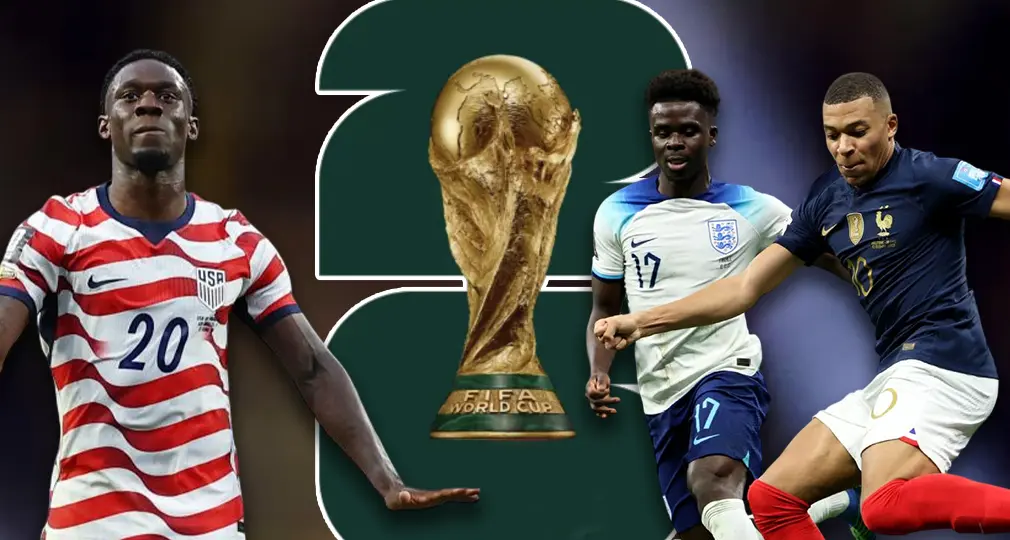
Honestly, the 2026 World Cup format looks huge at first glance, but the machinery is pretty simple once you strip away the noise. Forty-eight teams are split into 12 groups of four, every side gets three group matches, and 32 teams move into the knockout stage. That means 72 group games and 32 knockout games, so the full tournament lands at 104 matches across Canada, Mexico and the United States. The opening game is set for June 11 in Mexico City, while the final is scheduled for July 19 at New York New Jersey Stadium. That is wild, sure, but the extra round also gives us more meaningful table maths, more third-place drama and one more elimination game for the eventual finalists.
World Cup 2026 Format at a Glance
Basically, FIFA has kept the familiar four-team group idea and stretched the tournament around it instead of using awkward three-team sections. Each group contains four nations, each nation plays the other three once, and the standard 3-1-0 points system stays in place. The top two from every group qualify automatically, giving us 24 confirmed knockout teams, then the eight strongest third-place teams complete the Round of 32. A team reaching the final now plays eight matches rather than seven, which is a serious load after a long club season. Well, actually, that extra game is where squad depth stops being a talking point and starts deciding the trophy.
| Format Item | 2026 World Cup Number | What It Means |
|---|---|---|
| Participating teams | 48 | Sixteen more teams than in the previous 32-team format |
| Groups | 12 groups of 4 | Groups are labelled A through L |
| Group-stage matches | 72 | Six matches are played in every group |
| Teams advancing | 32 | 24 top-two finishers plus 8 third-place teams |
| Knockout matches | 32 | Round of 32 through the final, including the third-place game |
| Total matches | 104 | The largest match programme in World Cup history |
How the 12 Groups Work
Look, every group is a four-team mini-league, not some mysterious new FIFA invention. A side plays three times, collects points, and tries to finish first or second without needing help from another group. Six matches are played inside each group because four teams create six unique pairings, and the final two games in the same group are normally scheduled to kick off together. That simultaneous finish matters because nobody should know the exact target while a rival still has a later match to play. Anyway, the clean route is still the old route: win two games and you are usually safe, although the third-place safety net changes how aggressively teams manage the last ten minutes.
Points and Matchdays
Numbers-wise, a win is worth 3 points, a draw gives each team 1 point, and a defeat gives 0. The maximum after three matches is 9 points, while a team drawing all three ends on 3. Four points often looks useful in a third-place comparison, but it is not an automatic ticket because 12 third-place teams are fighting for only eight spots. For example, a 1-0 win and two narrow defeats may beat a 3-point record with a terrible goal difference. So the scoreline matters almost as much as the result once a team slips out of the top two.
- Win: 3 points
- Draw: 1 point
- Loss: 0 points
- Maximum group total: 9 points
- Matches per team: 3
- Matches per group: 6
Group Tiebreakers
Here, FIFA’s order is more head-to-head focused than many fans expect, so do not jump straight to overall goal difference. Tied teams are first separated by points earned in matches between those teams, then head-to-head goal difference, then head-to-head goals scored. If the tie survives, the calculation is reapplied where necessary before moving to overall goal difference, overall goals scored and team conduct points. Yellow and red cards can therefore hurt a team before FIFA rankings are used as the final separator. Honestly, that works because it rewards what happened on the field, though seeing a knockout place move on card deductions is still brutal.
- Points earned in matches between the tied teams
- Goal difference in matches between the tied teams
- Goals scored in matches between the tied teams
- Reapplication of the head-to-head criteria where required
- Overall group-stage goal difference
- Overall group-stage goals scored
- Team conduct score based on yellow and red cards
- Most recent FIFA men’s world ranking
- Earlier published FIFA rankings if the tie remains unbroken
How Disciplinary Points Work
Discipline-wise, FIFA does not simply count cards and call it a day. A yellow card costs 1 conduct point, a red caused by two yellow cards costs 3, and a direct red costs 4. A yellow followed by a direct red in the same match produces a 5-point deduction, while only one listed deduction is applied to a person in that game. The team with the higher conduct score ranks above the other team when this tiebreaker is reached. That is pretty savage, because one pointless card for delaying a restart can suddenly matter several days later.
| Card Situation | Conduct Deduction |
|---|---|
| Single yellow card | -1 point |
| Red card after two yellow cards | -3 points |
| Direct red card | -4 points |
| Yellow card plus direct red card | -5 points |
Who Advances to the Round of 32
Now, the qualification maths is straightforward: 12 group winners, 12 runners-up and 8 third-place teams advance. The 12 fourth-place teams are eliminated, along with the four weakest teams finishing third. That makes the group stage unusually forgiving compared with older editions, because two-thirds of the field survives the first phase. Still, between us, “forgiving” does not mean relaxed when one late goal can move a team from seventh-best third place to ninth. The pressure is real, and the live third-place table will be one of the most-watched screens of the tournament.
| Group Finish | Number of Teams | Outcome |
|---|---|---|
| 1st place | 12 | Advance to the Round of 32 |
| 2nd place | 12 | Advance to the Round of 32 |
| 3rd place | 12 | Best 8 advance; lowest 4 are eliminated |
| 4th place | 12 | Eliminated |
How the Eight Best Third-Place Teams Are Ranked
Third-place ranking ignores head-to-head results because the teams come from different groups and never played one another. FIFA compares all 12 third-place finishers by total points, then overall goal difference, then goals scored. If they are still level, team conduct points come next, followed by the latest FIFA men’s world ranking and then earlier rankings if the deadlock somehow survives. A third-place side with 4 points and a goal difference of zero will rank above another 4-point side sitting at minus one. That is great for clarity, but it also means scoring a third goal against a beaten opponent can become cold, practical tournament business.
- Total points from the three group matches
- Overall goal difference
- Total goals scored
- Team conduct score
- Most recent FIFA men’s world ranking
- Earlier FIFA rankings until the tie is broken
Why the Third-Place Race Changes Strategy
Tactically, the expanded qualification route changes what “good enough” means in the final group game. A coach sitting on 3 points may protect a one-goal defeat if the live comparison still shows the team inside the top eight third-place slots. Another coach may throw on two forwards because a single equaliser changes not only the points total but also the goal-difference swing. For example, losing 2-1 instead of 3-0 can be the difference between a Round of 32 berth and an early flight home. It is not always pretty, but this is where tournament football gets deliciously awkward.

How the Knockout Bracket Works
Knockouts begin with 32 teams and from there it is single elimination all the way. The sequence is Round of 32, Round of 16, quarter-finals, semi-finals, third-place match and final. A champion must survive five knockout rounds after playing three group games, so the total journey is eight matches. There are no two-leg ties, aggregate scores or replays if a match finishes level. This is cool because every mistake has a price right now, not next week in a return leg.
| Stage | Teams Entering | Matches | Teams Moving On |
|---|---|---|---|
| Round of 32 | 32 | 16 | 16 |
| Round of 16 | 16 | 8 | 8 |
| Quarter-finals | 8 | 4 | 4 |
| Semi-finals | 4 | 2 | 2 reach the final; 2 enter the third-place game |
| Third-place match | 2 | 1 | Bronze-medal winner |
| Final | 2 | 1 | World champion |
Round of 32 Pairings
Bracket-wise, group winners and runners-up have preassigned paths, while the eight third-place qualifiers are placed according to the combination of groups they come from. FIFA’s regulations contain 495 possible combinations for those eight third-place teams, which sounds like spreadsheet madness because, well, it is. The system still follows a fixed matrix rather than a fresh draw after the group stage. Teams from the same group are not paired against one another in the Round of 32, so an immediate replay is avoided. Although, let’s see, finishing first is still valuable because the bracket position and opponent profile are usually cleaner than the route offered to a marginal third-place qualifier.
Extra Time and Penalty Shoot-outs
Deadlocked knockout matches go to extra time after 90 minutes. Extra time consists of two 15-minute periods, with a five-minute interval after normal time and no standard halftime break between the two extra periods. If the score remains level after 120 minutes, the winner is decided by a penalty shoot-out. The referee tosses a coin to choose the end, subject to safety and pitch conditions, then another toss lets the winning captain choose whether to kick first or second. Penalties are chaos dressed as procedure, and yes, we are always glued to them.
World Cup 2026 Schedule and Match Load
Calendar-wise, the tournament runs for 39 days from June 11 through July 19, 2026. The group stage fills the opening stretch, the Round of 32 starts on June 28, and the Round of 16 follows from July 4. Quarter-finals begin on July 9, with the semi-finals on July 14 and 15, the third-place game on July 18 and the final on July 19. Teams are generally given at least three days of rest between matches, although the regulations allow an exception between the semi-finals and the third-place game. Anyway, travel and recovery are not background details here; across 16 host cities and three countries, they are part of the contest.
| Tournament Phase | Dates | Number of Matches |
|---|---|---|
| Group stage | June 11-27, 2026 | 72 |
| Round of 32 | June 28-July 3, 2026 | 16 |
| Round of 16 | July 4-7, 2026 | 8 |
| Quarter-finals | July 9-11, 2026 | 4 |
| Semi-finals | July 14-15, 2026 | 2 |
| Third-place match | July 18, 2026 | 1 |
| Final | July 19, 2026 | 1 |
How Many Matches Can One Team Play?
Physically, every qualified team is guaranteed 3 matches because nobody is eliminated before completing the group stage. A side knocked out in the Round of 32 plays 4 games, while a quarter-finalist reaches 6. Both finalists play 8, and the two losing semi-finalists also play 8 because they meet in the third-place match. That is one more game than finalists played under the old 32-team format. So, honestly, rotation is not optional if a manager wants fresh legs in mid-July.
- Eliminated in the group stage: 3 matches
- Eliminated in the Round of 32: 4 matches
- Eliminated in the Round of 16: 5 matches
- Eliminated in the quarter-finals: 6 matches
- Finalists and third-place participants: 8 matches
Betting and Tactical Angles to Watch
From a high-stakes punter’s seat, the new format creates prices that can look safe while hiding ugly table risk. Match three is the danger zone because one team may need a win, another may only need to avoid a heavy loss, and a third may be watching results from five other groups. Motivation is not binary, and the market can misread a side that is happy with a draw or even a narrow defeat. Besides, between us, cards matter twice now: they affect the match and can settle a qualification tie through the team conduct score. This is crazy in the best way, but only if you read the table before reading the odds.
- Check the live third-place ranking before the final group match.
- Track goal difference, not just points.
- Watch for rotation when a team has already secured qualification.
- Note yellow-card exposure because conduct points can break ties.
- Compare travel distance and recovery time between venues.
- Do not assume a favourite needs to win if a draw is enough.
Reading the Group Table Properly
Practically, start with points, then identify whether the tie is inside one group or across the third-place table. Inside a group, head-to-head criteria come first; across different groups, overall goal difference comes immediately after points. Next, calculate the consequence of one goal in either direction, because a late 2-1 can create a two-goal swing compared with 1-1. Then check discipline, especially if two third-place teams are level on points, difference and goals scored. It sounds obsessive, but honestly, it works.
Travel, Rest and Venue Effects
Travel-wise, this World Cup is spread across Canada, Mexico and the United States, with 16 host cities and several climate zones. A team can move from altitude or heat into a cooler coastal setting, and that change hits preparation even when the flight looks manageable on a map. FIFA’s schedule generally protects a minimum three-day rest window, but rest quality is not the same as rest quantity after airports, recovery sessions and media duties. For example, a deep squad playing at a controlled tempo may arrive fresher than a smaller squad that survived two end-to-end matches. That is not an excuse column; it is part of serious match analysis.
Quick Example: A Team Finishes Third
Suppose Team X finishes third with 4 points, a goal difference of +1 and 4 goals scored. Team Y also has 4 points but sits at 0 goal difference, so Team X ranks higher without needing the goals-scored tiebreaker. Team Z has 3 points and a +2 difference, yet it still ranks below both because points are compared first. If Team X qualifies, its Round of 32 opponent is not picked by a new draw but by FIFA’s predefined combination matrix. That little detail catches people every time, and it is why bracket calculators become essential once the final groups close.
| Third-Place Team | Points | Goal Difference | Goals Scored | Ranking Logic |
|---|---|---|---|---|
| Team X | 4 | +1 | 4 | Ranks above Team Y on goal difference |
| Team Y | 4 | 0 | 5 | Goals scored matter only after goal difference is tied |
| Team Z | 3 | +2 | 3 | Ranks below both because points are compared first |
Personally, I would treat the 2026 group stage as two tournaments running at once: the race for the top two and the cross-group race for eight third-place tickets. Do not stare only at the group your team is in, because the real qualification line may be moving somewhere else six hours later. Keep a live sheet with points, goal difference, goals scored and conduct deductions, then map the likely Round of 32 opponent before judging whether a late attacking push makes sense. The format is bigger, messier and occasionally ridiculous, but that is exactly why it produces value for anyone willing to do the arithmetic. One last note from the desk: when the market is watching the badge, watch the table.
Read more: England’s Chances of Winning