

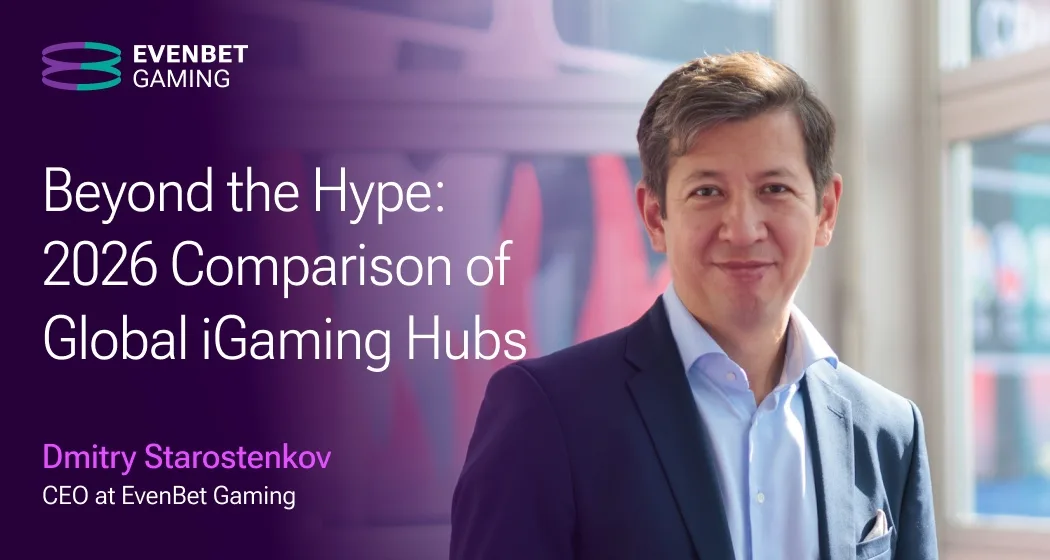
Welcome to another edition of our expert series. Today, we are joined by Dmitry Starostenkov, CEO of EvenBet Gaming. With experience in developing world-class poker and iGaming software, Dmitry has a unique vantage point on where the industry is moving. In this interview, we cut through the market noise to identify which global hubs are delivering real results in 2026.
Q: Dmitry, which region has definitively shifted from “emerging” to “dominant” this year?
A: If we are talking about explosive scale, it’s Latin America, led by Brazil, where the fully regulated market is now operational. But if you want to look at where the next massive structural shift is happening in 2026, you have to look at Africa and the UAE.
Africa has officially ceased to be just a “promising” region; it’s now an untapped goldmine for major international brands. The old stereotype that Africa is “only for sports betting” is dead. There is a massive, latent demand for alternative verticals like poker, but the entry barrier isn’t regulatory but technological.
To dominate in Africa today, you cannot just copy-paste a European platform. You have to adapt to the infrastructure.
Simultaneously, the UAE has established itself as the operational capital of global iGaming. Dubai is no longer just a glamorous backdrop for conferences; it has become the ultimate bridge between Asian capital and Western corporate compliance. While European hubs are bogged down in bureaucratic inertia, the UAE is building a tech-forward ecosystem that actively attracts Tier-1 founders and decision-makers.
Q: How has the UAE’s “GCGR” changed the landscape for offshore hubs?
A: The UAE has fundamentally professionalized the “offshore” concept. It’s now the primary bridge for Asian capital looking for Western transparency. We see many Tier-1 operators moving their strategic HQs there because the GCGR provides something Europe currently struggles with: a unified, tech-forward framework that doesn’t feel like it’s constantly playing catch-up with innovation.
Q: Malta (MGA) vs. Isle of Man (IoM) in 2026: who is winning the “gold standard” race?
It’s a classic battle of tech-driven agility versus the industry’s absolute emotional and operational core.
If you look purely at the numbers and compliance for cutting-edge Web3 or crypto-native rooms, the Isle of Man has built an incredibly sharp, fast-moving framework. But you can never count Malta out, because Malta wins with its heart and its community. It remains the true operational home of iGaming.
You can have the most advanced remote license in the world, but nothing replaces the power of look-them-in-the-eye networking. That is why Europe’s biggest decisions are still made here. In fact, we are proving this point right now: this May, EvenBet Gaming is partnering with the SiGMA Poker Tour to host a special 2026 edition freeroll on the island.
For us, it’s the perfect synergy. We are bringing our advanced poker software to a live, physical event to connect the best minds in the industry over a real card table. This blend of strict MGA regulatory heritage and unmatched community energy is why Malta doesn’t just hold the gold standard — it keeps the industry human.
Q: Are North American markets (USA/Canada) still the “Holy Grail”?
A: They are an incredibly lucrative tier, but the definition of success there has completely changed. The initial “Gold Rush” is over. Today, North America is a masterclass in operational efficiency and navigation of fragmented liquidity.
In the US, it’s no longer just about paying for market access; it’s about solving the player liquidity puzzle. If you aren’t structurally prepared for MSIGA (Multi-State Internet Gaming Agreement) to merge player pools across states like Michigan, New Jersey, and Nevada, your poker ecosystem simply won’t survive. Your R&D has to focus heavily on multi-jurisdictional compliance and seamless geo-fencing integration.
Meanwhile, in Canada, particularly Ontario, you are dealing with a heavily populated, yet completely segregated (ring-fenced) market. The competition there is brutal. Success in North America now requires heavy investment in localized marketing and retention tools. It’s a high-margin region, absolutely, but if your platform doesn’t support omnichannel solutions that let traditional land-based casinos easily convert their players into online users, the soaring compliance and operational costs will simply eat your profits.
Q: How does EvenBet Gaming adapt software to these diverse regional requirements?
A: We abandoned the “one-size-fits-all” philosophy years ago. Today, our adaptation strategy is built on absolute architectural agility, API-first integration, and player-centric product tailoring.
First, we don’t force operators to rebuild their core engine for a new market. Our platform acts as a modular ecosystem where you can seamlessly plug in specific components. If you are launching in a mature European market like Italy or our newly licensed Denmark, the focus is on hyper-strict, automated responsible gaming limits and immediate local reporting tools. If you are integrating into a massive sportsbook in Latin America or Africa, the challenge is completely different — it’s about engagement and lightweight tech.
This is exactly why we developed products like Spins Poker and One Click Poker. For sportsbooks whose users aren’t traditional poker players, we completely stripped away the overwhelming, classic poker lobby. Instead, we offer a fast, 3-minute, high-adrenaline tournament format with up to 1000x multipliers that delivers a “TikTok-style” immediate entertainment experience. Our modularity allows operators to “plug in” this vertical to their existing sportsbook or casino, turning a hub-specific license into a cross-vertical revenue driver.
Q: Is the Asian market finally stabilizing under the Philippines’ leadership?
A: It is being completely restructured. PAGCOR’s shift from the old POGO model to the strict IGL (Internet Gaming Licensees) framework has successfully brought corporate transparency to the region, proving that a regulated B2B ecosystem can thrive in Asia.
To win here in 2026, your tech must match local player psychology. Asia is the global capital of vertical-screen, mobile-first gaming. Western players prefer desktop multi-tabling, but Asian users demand seamless one-handed mobile play, heavy gamification, and social elements like real-time interactive gifts and club-based mechanics. PAGCOR provided the regulatory anchor, but software adaptability is what actually drives the revenue.
Q: Sum up your 2026 strategy in one sentence.
A: Simplify the entry through modularity, and dominate the market through fast, social-centric innovation.
Conclusion
Navigating the 2026 landscape requires a realistic, data-driven approach to far more than just legal frameworks. As Dmitry Starostenkov highlights, the winners are those who combine regulatory agility with tech that matches the “TikTok” speed of modern players whether that means unlocking Africa with lightweight mobile solutions or capturing fragmented liquidity in North America.
With EvenBet’s recent expansion into the Danish market, their integration of AI-driven engagement, and their upcoming Poker Tournament at Ace Alliance Riga 2026 in August, the message is clear: the future of iGaming is fast, social, and relentlessly efficient.
When compliance costs rise, your software needs to work harder. Contact EvenBet Gaming today to see how our AI-driven, modular solutions seamlessly integrate into your existing ecosystem to maximize turnover.