


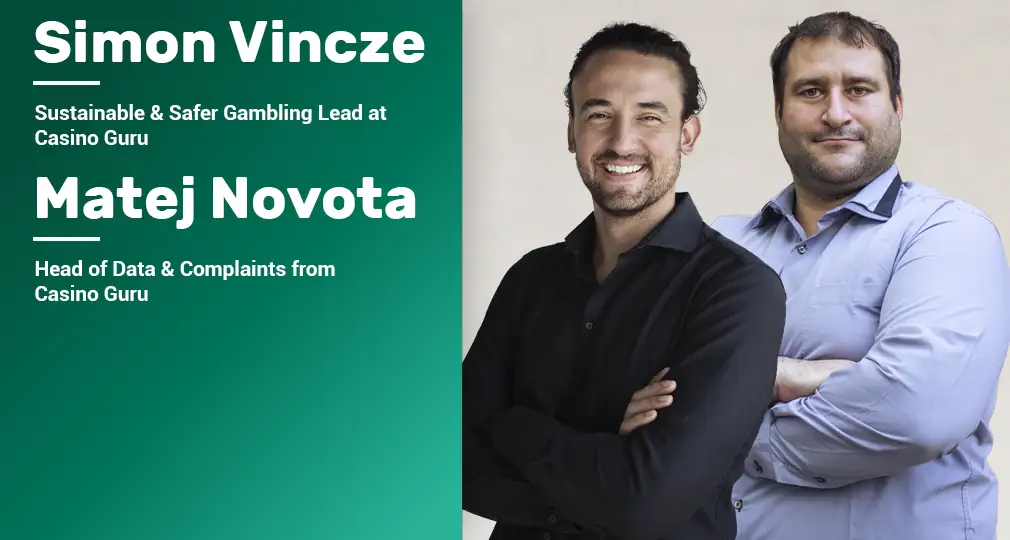
In this exclusive interview, Casino Guru representatives Simon, Sustainable & Safer Gambling Lead and Matej, Head of Data & Complaints discuss the evolution from Responsible to Sustainable Gambling and the company’s ongoing mission to make online gaming fairer, safer, and more transparent.
Simon, can you explain Casino Guru’s philosophy behind “Sustainable Gambling” and how it differs from traditional “Responsible Gambling” initiatives?
Sustainable gambling is a holistic approach to reducing gambling-related harm. It considers all stakeholders involved, with the ultimate aim of making gambling activity sustainable for everyone. A basic example is the relationship between operators and players, where the former makes a profit while doing their best to keep players safe, and the latter enjoys gambling while being aware of the risks and actively managing them. Responsible gambling by design primarily places responsibility on operators to inform about those risks and signpost to help, while players should also bear responsibility for their actions.
What are some of the most common challenges you see when trying to implement safer gambling practices?
Safer gambling sits somewhere between the two terms mentioned above. I prefer to discuss them in terms of evolution, but they are often used interchangeably. This presents one of the challenges in implementing effective policies, as operators may lack a clear definition of their ultimate goal. Relying solely on regulation will not add value for them; it will only lead to ineffective frameworks. Safer gambling has significant potential to add value for operators through improved retention, brand recognition, and player satisfaction.
In your view, what does a “fair and safe casino” look like in 2025?
There is a very specific list of requirements in order for a casino to be considered as such by Casino Guru. Interestingly, it is less about the risks connected with problem gambling, but is focused more on the players’ experience and reliability to get fair treatment with the money players use. Such a casino must have no hidden clauses that could be potentially used as a pretext for confiscating winnings or deposits. Furthermore, it should have features to prevent unintentional violation of their terms, such as the maximum wager, restricted games or other requirements during bonus play.
Are there emerging technologies (AI, data analytics, blockchain) that could strengthen responsible gambling efforts?
Technology acts as an enabler to enhance effectiveness in such efforts, but it demands meaningful human input, especially in communicating with players. Currently, the most discussed technology areas are AI and data analytics, which can lead to highly personalised nudges or interactions. However, there is a risk that this technology could be exploited to manipulate players rather than assist them. I recognise that regulation is progressing towards stronger oversight in these areas, but it will take some time.
Matej, Casino Guru’s Complaint Resolution Center has helped players recover over $52 million. What does it mean for the business? How do you achieve such effectiveness?
Meeting the milestone of about US$52 million in resolved player complaints since the launch of the Casino Guru Complaint Resolution Center (CRC) in 2019 speaks volumes about our credibility and trustworthiness in the gambling community. It shows that Casino Guru is not just a passive reviewer, but an active mediator that is able to bring tangible results to players. These tangible results strengthen players’ faith in our reviews, Safety Index, and recommendations.
In a sector full of casino review sites and affiliate sites, the presence of a fully operational dispute-resolution service sets us apart. It underlines our ethos of supporting fair and safe casinos, as opposed to merely promoting appealing bonuses.
CRC also enhances our position in the industry. It allows us to sit across from regulators, operators, and other stakeholders from a position of strength, supported by real facts on complaints and their resolution. This gives more weight to our voice at the policy as well as operational levels of engagement.
Our effectiveness comes from combining transparency, data-driven processes, and a genuine commitment to fairness.
What are the most common types of complaints players file against online casinos?
The most common type of complaint we continue to see involves delayed payments. This trend has persisted over the years, with the majority of all complaints still relating to payout delays.
How do you ensure fairness and impartiality when mediating between players and casinos?
We approach every complaint by carefully examining the situation from both the player’s and the casino’s perspective. When necessary, we discuss complex or unclear cases as a team and make decisions collectively. This collaborative approach ensures consistency and fairness, as it allows us to apply the same standards and reach similar outcomes in comparable situations.
How does the complaints data influence your broader casino review methodology and safety ratings?
We use complaints data as a key part of our reviewing process. By looking at how many serious, justified complaints a casino has and comparing that with its size (how many players it has and how much business it does), we build a score that reflects the likelihood a player will be treated fairly and get paid.
Casino Guru claims to have influenced over 700 gambling platforms to change their Terms & Conditions. How did that initiative come about? What did you do to achieve such goal?
We embarked on this challenging task for two primary reasons. First, we’ve been collecting data on online casinos for years. In mediating player complaints, we’ve encountered instances where casinos enforced their terms, yet players’ funds were unjustly confiscated based on unfair term. Comparing how different casinos handled the same situations using our extensive data, we identified areas where they could do better. Surprisingly, there were casinos with well-constructed terms that minimized mistakes, so we thought of recommending the same approach to other casinos.
It was most difficult to convince the first ten casinos. However, as more and more casinos realized we did not have any intention to offend them but rather promote the creation of fair and transparent terms, they understood the mutual benefits to themselves as well as their customers. As such, an increasing number of them agreed to change their terms. This year, we also started showing these unfair practices on our website, giving the casinos another incentive to change their terms.
The Casino Guru Academy offers educational resources for casino employees. What impact have you observed from these programs?
Our goal has always been to impact players through the operators who use our courses. We are doing our best to demonstrate the real value of fairness to their customers and maintain a close eye on their activities to minimise harm. That said, we are unable to measure impact directly. However, we see that our courses are appreciated by operators and other stakeholders, as evidenced by their return.
What’s next for Casino Guru in terms of innovation, policy influence, or global outreach?
(Simon) In the terms of player protection, we are working on a new rating which will reflect different tools and resources offered to players. Safety index is not directly connected with this area so our aim is to provide evaluation on protection capabilities of every casino. Operators are keen to change T&C to get better Safety Index and we want to achieve similar mechanics in the area of player protection.
(Matej) Very soon we will introduce a groundbreaking feature developed in collaboration with Gamecheck. As the first platform to implement this feature, we’ll provide players with direct insights from Gamecheck, confirming whether a casino offers genuine games or not.
Read More: CMO Peter Gunni Evaluates Social Media Marketing Trends in the iGaming industry