


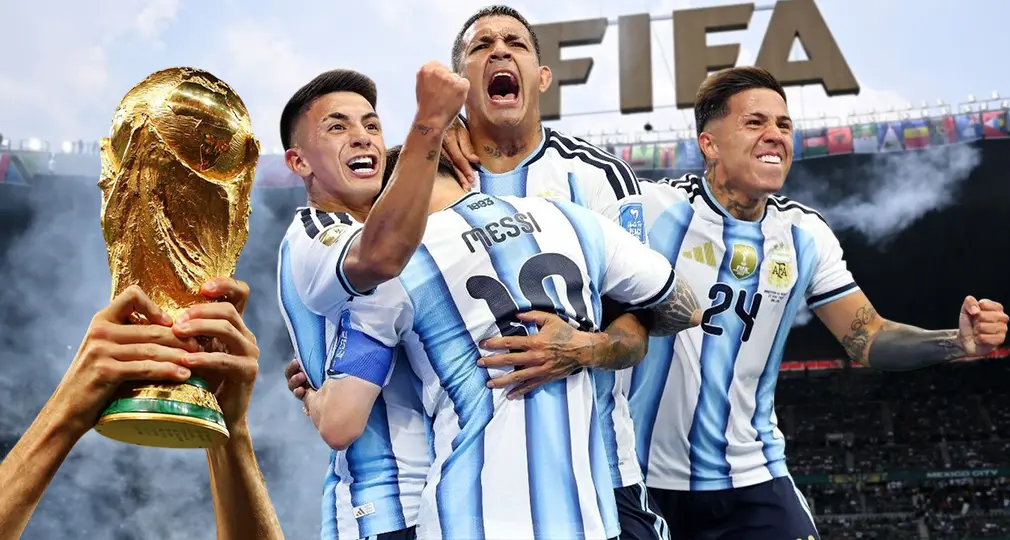
Right now, calling this Argentina’s last dance feels dramatic, but not exactly wrong. Lionel Messi is about to turn 39, Nicolás Otamendi is already 38, and several members of Lionel Scaloni’s trusted circle are entering the expensive end of the mileage chart. Well, actually, the team does not look old when it starts moving the ball — it looks experienced, nasty to play against and still completely convinced that big matches belong to them. Argentina have opened World Cup 2026 with two wins, five goals scored and none conceded, so the machine is clearly not coughing yet. The question is whether this champion generation has enough fuel for an eight-match title run, because that is where things get properly wild.
Argentina’s World Cup 2026 position right now
Honestly, the opening numbers are almost suspiciously clean. Argentina beat Algeria 3–0, followed that with a 2–0 win over Austria and booked a place in the Round of 32 with one group match still to play. Lionel Messi has scored all five of Argentina’s goals, which is amazing, ridiculous and a little dangerous at the same time. The defence has allowed zero goals, Emiliano Martínez has not had to perform one of his full circus routines yet, and the team sits on six points. In any case, qualification is handled, while first place in Group J still needs to be finished against Jordan.
| Current group | Group J |
|---|---|
| Record after two matches | 2 wins, 0 draws, 0 defeats |
| Goals | 5 scored, 0 conceded |
| Current status | Qualified for the Round of 32 |
| Messi at World Cup 2026 | 5 goals in 2 matches |
| Messi’s career World Cup total | 18 goals |
| 2026 qualifying finish | 1st in CONMEBOL, 38 points |
| Final qualifying record | 12 wins, 2 draws, 4 defeats, +21 goal difference |
| Squad size | 26 players |
| Qatar 2022 returnees | 17 players |
Why the “last chance” label is not cheap clickbait
Basically, four trophies have turned this group from a good national team into a historical unit: Copa América 2021, the 2022 Finalissima, the 2022 World Cup and Copa América 2024. Those wins were not collected by four different squads, either; the spine stayed together, learned how to suffer and became almost annoyingly calm when matches got ugly. Messi, Otamendi, Martínez, Tagliafico, De Paul and Paredes have lived through the entire climb from near-misses to serial winning. Besides, between us, expecting all of that core to return at full power for the 2030 World Cup would be a heroic piece of optimism. This may not be the last tournament for every champion, but it is probably the last World Cup where the old gang arrives as one functioning block.
| Age group | Players | Share of squad | Examples |
|---|---|---|---|
| 30 or older | 9 | 34.6% | Messi, Otamendi, Martínez, De Paul, Tagliafico |
| 26–29 | 11 | 42.3% | Álvarez, Lautaro, Romero, Molina, Mac Allister |
| 25 or younger | 6 | 23.1% | Nico Paz, Barco, Almada, Enzo Fernández |
Approximate squad average: 28.6 years
The champion core still controls the important zones
Look, Argentina did not bring 17 Qatar survivors because Scaloni enjoys nostalgia nights. Emiliano Martínez still owns the penalty area, Cristian Romero supplies the aggression, Otamendi manages the line, Rodrigo De Paul eats kilometres and Messi decides when a normal attack becomes a headline. Alexis Mac Allister, Enzo Fernández, Julián Álvarez and Lautaro Martínez are not old passengers either — they are prime-age starters with a World Cup already in the bag. That combination is cool because the veterans carry the emotional memory while the younger champions handle more of the running. It works, honestly, because responsibility is spread across the pitch even when every television camera remains glued to number 10.
- Emiliano Martínez: goalkeeper, organiser and Argentina’s emergency button in shootouts.
- Cristian Romero: front-foot defender who attacks duels before forwards can turn.
- Nicolás Otamendi: veteran line leader, aerial defender and set-piece threat.
- Rodrigo De Paul: pressing runner, second-ball hunter and Messi’s tactical bodyguard.
- Alexis Mac Allister: press-resistant connector between recovery and possession.
- Enzo Fernández: progressive passer who can change the direction of an attack early.
- Lionel Messi: creator, finisher, tempo switch and apparently the entire scoring department.
Scaloni’s quiet rebuild is the part people keep missing
Meanwhile, the squad is not some museum exhibition with shin pads. Nico Paz and Valentín Barco are 21, Giuliano Simeone is 23, while Thiago Almada, José Manuel López and Enzo Fernández are 25. Scaloni has added quicker legs, more one-versus-one ability and several players who are not emotionally dependent on the 2022 story. For example, Paz can receive between lines, Barco can progress the ball from deeper positions, and Simeone brings the kind of direct running that annoys tired full-backs. So the real plan is pretty clever: keep the champions who understand pressure, then hide fresh energy around them.
- Nico Paz: left-footed creativity between midfield and attack.
- Valentín Barco: aggressive ball progression and positional flexibility.
- Giuliano Simeone: vertical running, pressing and width.
- Thiago Almada: close control, combinations and set-piece quality.
- José Manuel López: penalty-box presence and a different physical profile.
- Leonardo Balerdi: a faster central-defensive option for a higher line.
What the first two matches actually showed
Numbers-wise, five goals and two clean sheets look like total domination, but the tape gives us a slightly messier answer. Algeria allowed Messi too much working room and paid for it three times, while Austria made Argentina grind before losing 2–0. Messi even missed an early penalty against Austria, then scored in the 38th and 95th minutes because apparently normal match scripts no longer apply to him. Argentina were patient rather than frantic, and that is a very useful habit in a tournament where one stupid ten-minute spell can wreck four years of work. Though, let’s see how comfortable it looks when an elite opponent presses Enzo and Mac Allister instead of backing away.
Argentina’s World Cup 2026 results so far
| Date | Opponent | Result | Argentina scorers | Main read |
|---|---|---|---|---|
| 16 June 2026 | Algeria | 3–0 | Messi 17′, 60′, 76′ | Clinical start, space punished, clean sheet |
| 22 June 2026 | Austria | 2–0 | Messi 38′, 90+5′ | Harder physical test, patient control, late kill |

Messi at 39: miracle, solution and obvious risk
Personally, five goals in two games at this age is madness, and there is no sensible way to make it sound routine. Messi now has 18 World Cup goals, has moved beyond every previous tournament scorer and is playing in his sixth World Cup. He turns 39 on 24 June, yet Argentina’s attack is still being settled by the same left foot that carried the team through Qatar. This is fantastic when he scores a hat-trick and a brace, but it also leaves an obvious question: who finishes the chances when Messi finally has a quiet night? In any case, Álvarez, Lautaro, Almada and Paz must start producing goals before the knockout bracket begins throwing punches.The beautiful and slightly terrifying stat: Lionel Messi has scored 100% of Argentina’s first five goals at World Cup 2026.
The new format makes squad management a serious game
Tactically, winning this World Cup demands more than finding one perfect starting eleven. The 48-team format contains 12 groups of four, with the top two teams and eight best third-placed sides entering a new Round of 32. A finalist can now play eight matches instead of seven, so extra time, travel and recovery can pile up fast. Scaloni needs to rotate without breaking the team’s rhythm, particularly around Messi, Otamendi and the midfield runners. That sounds simple on a whiteboard, but by match seven the legs normally send their own tactical instructions.
- Three group-stage matches.
- Round of 32.
- Round of 16.
- Quarter-final.
- Semi-final.
- Final or third-place match.
A champion at World Cup 2026 must survive eight matches across roughly five weeks.
Argentina’s route out of Group J
Schedule-wise, Argentina have already removed most of the group-stage panic from the equation. Their final match is against Jordan in Dallas on 27 June, and a win guarantees first place without anyone reaching for a calculator. Finishing first sends Argentina to Miami on 3 July against the runner-up from Group H, while second place would mean Los Angeles on 2 July against the Group H winner. Spain, Uruguay, Cape Verde and Saudi Arabia make that neighbouring group awkward enough to watch closely. So, yes, beating Jordan matters — not for survival, but for control of the travel plan and the first knockout matchup.
Possible next steps for Argentina
| Scenario | Date | Venue | Opponent |
|---|---|---|---|
| Final Group J match | 27 June | Dallas Stadium | Jordan |
| Argentina finish 1st in Group J | 3 July | Miami Stadium | Runner-up of Group H |
| Argentina finish 2nd in Group J | 2 July | Los Angeles Stadium | Winner of Group H |
Betting read: where the market can make you pay
Betting-wise, Argentina’s name, two clean sheets and Messi’s five goals create exactly the kind of shiny favourite that casual money loves chasing. The dangerous move is paying any price just because the shirt has three stars and the captain looks immortal again. Check the starting lineup, expected Messi minutes, midfield rotation and knockout incentive before touching a short number. Besides, between us, group matches with qualification already secured can become strange little creatures — slower tempo, unexpected starters and no interest in winning by four. The smarter angle may appear live after the first 10 or 15 minutes, once Scaloni’s actual shape is visible rather than guessed.
- Confirm whether Messi, De Paul and Otamendi start.
- Check whether Argentina need a win to secure first place.
- Compare the moneyline with handicap and team-goal markets.
- Do not price the next opponent using reputation alone.
- Watch travel days and possible extra-time accumulation in the knockout stage.
- Avoid emotional recovery bets after one bad result.
What must go right for Argentina to repeat
For another title to happen, Argentina need more than Messi converting every useful touch into folklore. At least two other forwards must join the scoring, the centre-backs must stay healthy, and Scaloni needs to protect the older players without sacrificing first place or rhythm. Mac Allister and Enzo have to beat pressure cleanly because stronger teams will try to cut the supply line before Messi receives between the lines. Martínez must remain ready for the one-save match, the sort where a goalkeeper watches for 80 minutes and then gets one horrible decision to make. Most importantly, Argentina must keep the emotional control that won Qatar — no cheap cards, no stupid retaliation and no panic when a knockout match stays 0–0.
- Secondary scoring: Álvarez and Lautaro cannot remain passengers.
- Midfield control: Enzo and Mac Allister must escape aggressive presses.
- Veteran recovery: Messi and Otamendi need carefully managed minutes.
- Defensive health: Romero and Lisandro Martínez provide pace and aggression.
- Bench impact: Almada, Paz, Barco and Simeone must change match tempo.
- Penalty readiness: knockout football rarely asks permission before becoming chaos.
Gut-level, this feels less like a farewell tour and more like champions trying to steal one more night before the lights come on. Argentina are organised, qualified, unbeaten and still have the most decisive player in the tournament, which is a pretty outrageous starting hand. The warning is obvious: Messi has scored everything, the schedule is longer, and the old core cannot play every minute as if the calendar stopped in Qatar. Though, let’s see — Scaloni has solved uglier problems than this, and the younger layer of the squad is better than people admit. I would not call Argentina invincible, but I absolutely would not sit across the table from this generation and assume it has finally run out of chips.
Read more: Can France Win a Second World Cup Title